Background
Since early 2026, conflicting claims have been piling up: a widely cited report predicts the product manager will be gone by 2030; major tech companies are cutting product teams in favor of AI roles; LinkedIn replaced its Product Manager associate program with a Product Builder program, and Linear followed suit. Marty Cagan writes that the Product Owner - the Agile role - is being absorbed by AI and engineers. And Andrew Ng argues, on the surface, the opposite: that product is becoming the new bottleneck.
Each a respected source, each reaching a different conclusion and none of them built for a fifty-person Dutch software company. That gap was the reason for this study: rather than lean on Silicon Valley narratives, we set out to find what's actually changing at Dutch software scale-ups and SMEs.
On September 16, 2026, we shared our first findings in a webinar, including a conversation with a product leader whose organization ran the most far-reaching experiment in our dataset.
This article lays out the full research findings for anyone who couldn't attend the webinar, or who wants to see the evidence behind the conclusions, including findings that didn't fit into the webinar itself.
PO and PM: Role vs Job Title
In the debate about the future of product management, the terms Product Owner and Product Manager are used interchangeably, and that muddies the discussion. A product owner's role in Scrum has evolved over time, but in practice, administrative versions of the role often obscure what strong product management actually looks like. When this article discusses classic PO work disappearing, we don't mean the role as it was intended, but the administrative form we encounter at many organizations. The question this article addresses is what AI does to the work that so often obscured it.
Methodology and Sample
The findings in this article draw on three sources: a survey of 59 product professionals at Dutch software organizations; 20 in-depth interviews with product managers, product owners, heads of product, and CEOs/MDs at software scale-ups and SMEs with up to 250 employees, across sectors ranging from e-commerce to accounting software and telecom; and an analysis of 78 product job postings collected from Dutch software companies.
The sample is self-selected through 25Friday's network, which is well suited to spotting direction and patterns, but not to producing hard percentages representative of the entire Dutch market. The interview questions were deliberately designed to be non-leading: the working hypotheses behind this research were never presented to participants, to avoid steering the answers.
Based on observations from client engagements and the conflicting claims described above, we formulated three working hypotheses in advance: (1) the work is shifting from execution to judgement; (2) the balance between product and engineering is tipping; and (3) role boundaries between product and engineering are blurring. These are tested hypotheses, not assumptions: when the evidence would not have supported a hypothesis, we reported just that.
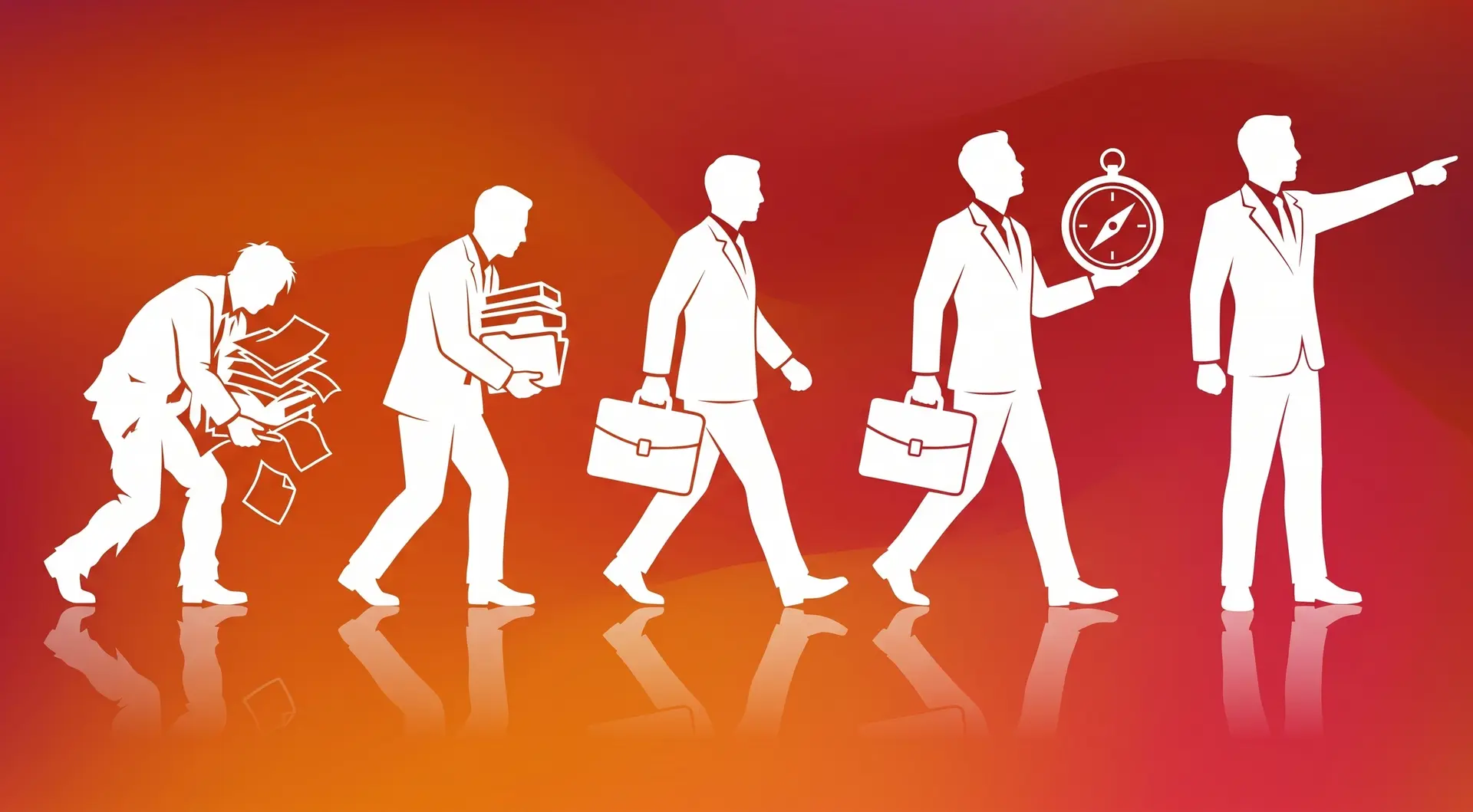
Finding 1: Product Work is Shifting from Execution to Judgment
Of all the patterns in this research, this one is the least contested. AI is used most for writing PRDs and specs, data analysis, and prototyping, and it's precisely on those tasks that time spent has dropped the most, often to less than a third of what it used to take. The tasks least affected are gathering feedback, stakeholder alignment, and roadmap planning: tasks built around convincing people and making choices, not producing documents.
How AI is used in decision-making shows that people retain control: 90% of respondents describe AI's role as input and support, with humans deciding. Only a small share gives AI a bigger role.